
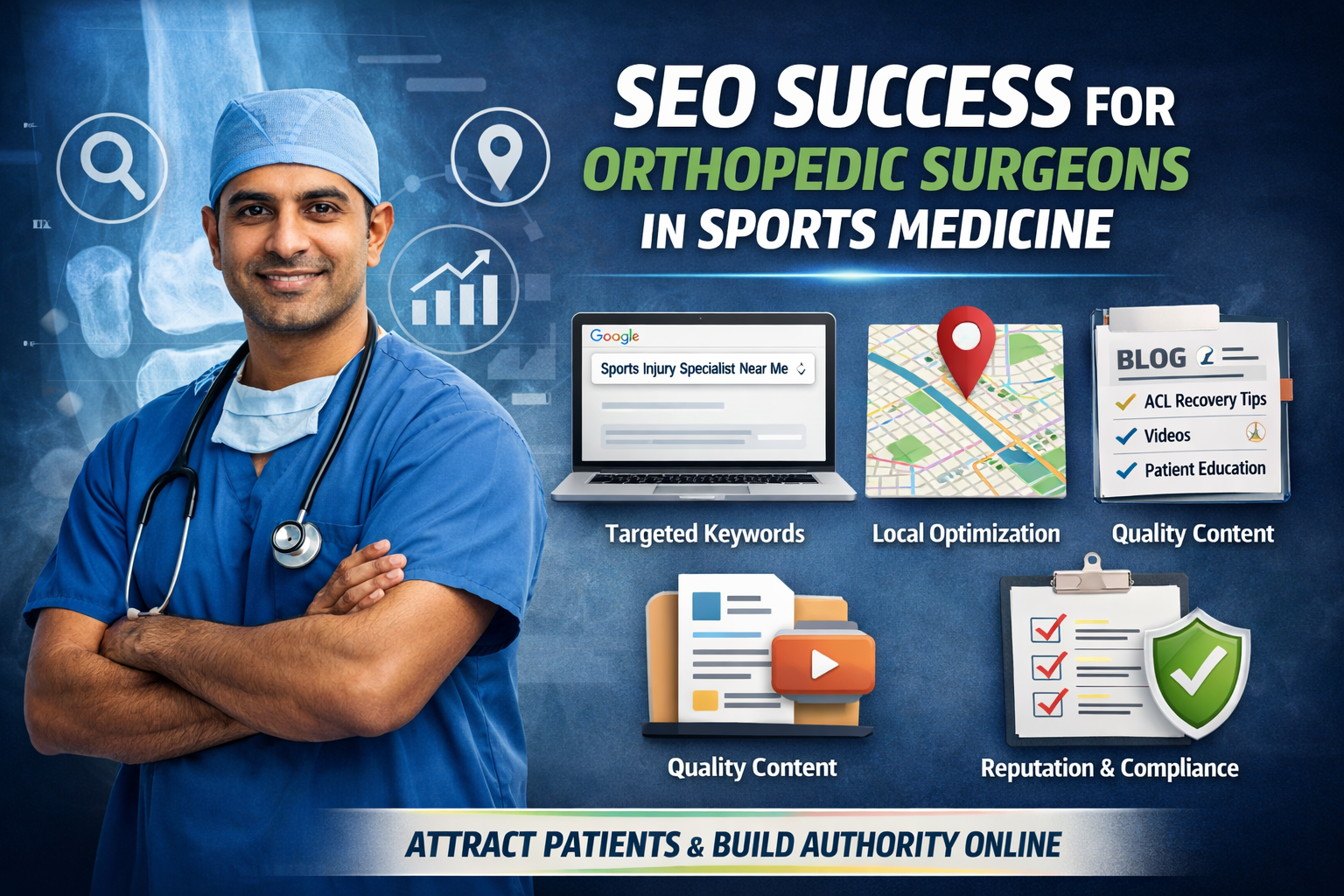
How Orthopedic Surgeons in Sports Medicine Can Win with SEO
In an era where athletes and active individuals turn to Google before booking an appointment, orthopedic surgeons in sports medicine must treat SEO as a core growth strategy—not a marketing add-on. This guide outlines proven tactics to increase online visibility, attract high-intent local patients, and establish long-term authority in a competitive healthcare landscape.
Bryan
CPO
Today’s digital-first healthcare environment makes it so that patients are no longer only leaning toward getting referred. Most patients start doing their own research and searching on Google, whether they are a high school athlete with a torn ACL or a weekend warrior with long-term knee pain.
Having a strong online presence has become mandatory for orthopedic surgeons practicing sports medicine, not optional. The development of a well-established SEO strategy can help ensure that potential patients find your practice when searching for treatments for sports-related injuries, rehabilitation from sports-related injuries, or sports-related orthopedic care in your geographic area.
Here’s a list of the best SEO strategies for sports medicine orthopedic surgeons who want to increase their visibility, bring in the right patients, and establish credibility and authority over time.
1. Search Engine Optimization Strategies Use Keyword Research to Define Keywords
The foundation of any successful SEO campaign relies on keyword research. The primary goal, through your keyword research, is to figure out what prospective patients are searching for.
Focus on High-Intent Keywords
Target keywords, as follows, signify clear intent on the part of the prospective patient to treat an injury. For example:
· “Sports injury specialist near me”
· “Orthopedic surgeon for athletes”
· “ACL tear surgery”
· “Rotator cuff treatment”
· “Knee pain treatment in [name of city]”
· “Sports medicine doctor for runners”
These keywords indicate that consumers want to find a doctor, more specifically, that they want to find a sports medicine physician rather than just any physician.
Use Geographically-Specific Keywords
Due to the nature of orthopedic services being geographically based, geographically targeted key phrases play a major role such as:
· “Sports medicine physician in Dallas”
· “Leading orthopedic practitioner in Los Angeles”
· “Knee orthopedist near Chicago”
Long tail keyword phrases typically yield more conversion rates because they provide more details.
2. Generate Relevant Patient-Centered Website Material
Your website is your online clinic. The purpose of your website is to educate and provide comfort to patients who visit until they eventually have made it to the point of making an appointment.
Build Service Page Locations
Do not try to have multiple services listed on one page; instead create unique pages focusing on a specific service, such as:
· Anterior cruciate ligament (ACL) reconstruction
· Medial meniscus repair
· Glenohumeral joint arthroscopy
· Medical ligamentous elbow repair
· Rehabilitation Program for Athletes
Each page should cover the following topics like:
· “Signs of the problem”
· “The Cause of the Problem”
· “Ways to Fix The Problem”
· “Expectations During the Healing Period”
· “Frequently Asked Questions”
· “Call-to-Action (Book an Appointment)”
Add Educational Blog Posts
Continuing to publish information on a blog does two things; it improves your ranking on search engines and establishes your knowledge. Possible examples of some topics you could write about are:
· “How Long to Heal from ACL Injury”
· “Most Common Injuries and Treatment to an Athlete in Baseball”
· “Ways to Avoid Injuries while running”
· “When should you see a sports physician?”
Therefore, this helps forming a trust relationship and targeting informational keywords.
3. Become a Master of Local SEO to Increase Chances of Receiving Public Attention
Most patients will look for orthopedic surgeons where they reside. Local Search engine optimization will give you a better chance at making your appearance in the local pack of Google.
Optimize Your Google Business Profile
Your Google My Business listing (GMB) should reflect:
· Accuracy (Name, Address, Phone number).
· Updated (office hours).
· Quality clinic (photos).
· Services performed (specifications).
· Link to make an appointment.
Location pages can help (if you have multiple locations)
If you have multiple locations create different locations pages for each such as:
· Sports medicine (Houston)
· Ortho (Miami)
Make each location page different and unique and have local content.
4. Optimize by Leveraging Patient Reviews for Both Trust and Search Engine Rankings
Online reviews have a large impact on both trust and search engine ranking as well as on patient decision making.
Encourage Reviews Ethically
Request reviews from patients using the following methods:
· Health Grades
· Vital
· Yelp
Respond to Reviews Professionally
Respond to all reviews (both positive and negative) in a professional manner demonstrating professionalism, you build trust, and provide engagement signals.
Overall, having more high quality reviews will increase your visibility in search engine results pages (SERP) for local searches.
5. Ensure that your Website is Mobile Optimized and has a Great User Experience
More than 60% of the time that people are searching for health care services, they are doing so via mobile phone or other mobile devices.
To provide a great mobile experience for the visitor, your website must have the following:
· Fast load time (less than three seconds)
· Buttons that are easy to click on
· Easy appointment scheduling form
· Call to action on phone numbers
Google gives preference based on whether the website is mobile friendly, regardless of the other factors in the search algorithm; so this must be done.
6. Create Quality Back links
Back links represent an endorsement from different websites.
Authoritative back links may come from:
· Medical journals
· Sports governing bodies
· Blogs about training athletes
· Hospital systems
· Media outlets at the local level
· The athletic departments of colleges or universities
Writing guest articles and networking through community events can garner high-quality links organically. Focus on quality over quantity (as far as link building practices). Do not approve of spammy link-building methods.
7. Use Social Media to Increase Visibility
While it will not directly affect your ranking opportunities, social media enhances the visibility of your brand and builds engagement.
Best Platforms for Sports Medicine Specialists
· Instagram (injury prevention tips, rehabilitation routines)
· Facebook (educational content and patient information)
· LinkedIn (showcase your expertise as a professional)
· YouTube (explain different treatment options)
By sharing relevant educational resources, you can establish credibility and increase referral traffic back to your website.
8. Prioritize Technical SEO
Technical SEO supports your site’s ability for search engines to crawl and index correctly.
Technical SEO Considerations
· Secure site (HTTPS)
· Submit XML Sitemap
· Page speed is fast
· Clean URL structure
· Correct use of header tags (H1, H2, H3)
· Utilize schema markup for medical professionals
Utilizing structured data on your site assists search engines with understanding facts like:
· What your specialty is
· Your location
· What people are saying about you (e.g., reviews)
· Provide a list of your services
This will often result in enriched results from searches.
9. Video Marketing Engagement
Using video content is very effective when marketing healthcare.
Video marketing content examples for sports medicine SEO include:
· “What does an ACL surgery look like?”
· “What can you do to avoid shoulder injuries if you swim?”
· “How long will it take after meniscal surgery to recover?”
· “Animated video for education to patients.”
The content you create as a video on YouTube may also be optimized to rank on Google, giving you more visibility. Moreover, embedding your videos into your website will also increase how long people stay on your site to view those videos, which is a positive factor for SEO.
10. Creative Patient Education Resources
Engaging patients through long-form guides, downloadable resources that contain valuable information about injury prevention, rehabilitation after surgery or recovery processes will establish authority for your practice and create trust with your patients.
Resources available for you to consider creating include:
· “Ultimate Guide to ACL Injury”
· “Athletic Injury Prevention Handbook”
· “Post-Operative Recovery Checklist”
· “Infographic for Common Sports Injuries”
The more valuable and helpful your resources, the more likely the patients will see you as an authority or resource for their needs.
11. Measure, Monitor or Optimize Performance
Search engine optimization (SEO) is a continuous process and requires ongoing work for any benefits to be realized from the work completed.
Some key metrics to monitor would be:
· Organic traffic
· Keyword ranking
· Appointment scheduling
· Bounce rate
· Engagement time on your pages
· Conversion rate
Use the following tools to gain analytical and metric data on how well your website is performing:
· Google Analytics
· Google Search Console
· Call tracking programs
Evaluate the pages that drive patient interest or inquiries and improve the performance of pages that underperform.
12. Comply With Legal and Ethical Guidelines in Medical Marketing
Medical SEO must comply with legal and ethical guidelines.
Some of the major areas to keep in mind are:
· No misleading statements about what a medical professional is able to do (i.e., “guaranteed recovery)
· Protect patient information (i.e., HIPAA)
· Research studies or their results should be presented without bias
· Disclaimers regarding limitations of the medical care you provide
Trust and credibility are very important for marketing health care services.
13. Build Authority with Expertise and Credentials
Be very visible with your credentials (i.e., the facts) by reflecting them with the following:
· Board certifications
· Fellowship training in sport medicine
· Years of operation
· Research published
· Media appearances
Google considers the E-E-A-T when ranking a doctor’s website. So the physician who has the E-E-A-T has a greater chance to rank higher.
Final Thoughts
For a sports medicine physician to be ranked high by Google requires more than just ranking on the search engines. The goal is to be an expert source for patients that require medical care.
A sports medicine physician’s digital presence will come from being an expert source through:
· Strategic Keyword Research
· Creating High Quality Content
· Local SEO
· Improvement in Technical Aspects of URL
· Managing Reputation
· Creating Educational Videos
· Establishing Credibility and Compliance
Therefore, if all of these areas are combined, an orthopedic surgeon specializing in sports medicine creates an excellent digital presence to attract qualified patients consistently.
A strategic SEO plan places you in front of athletes or active people when they need it most from a healthcare provider.
Ready to Grow Your Business?
Let our team of experts help you implement these strategies and drive real results.
Get a Free Strategy Audit